
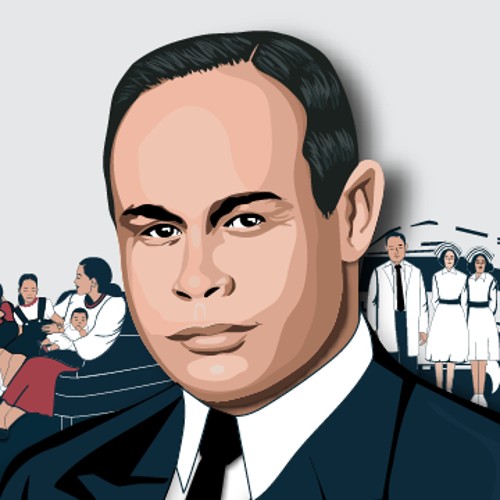
Iconic ExcellenceThe Legacy of Dr. Charles R. Drew
An interactive eBook. Read his story, watch the film, play the games, hear the song, and meet the Tucson voices carrying his work forward.
Legacy Makers · Interactive Edition


Hi, I'm Coach Lucy.

This book is a little different. It doesn't just tell you about Dr. Charles R. Drew. You get to do things inside it: watch, flip, play, listen and pledge, right on the page.
Dr. Drew figured out how to store blood safely and get it to the people who needed it. The Red Cross blood program he launched in 1941 still saves lives every day, including for people living with sickle cell.
👉 Tap the edges of the page, swipe, or use the arrows to turn pages. Look for the dark bars. They mark something you can play with. ☰ Chapters jumps anywhere. Aa gives you a large-print text view, and 🔊 reads the page aloud.
You earn LEARN It Coins as you read. When you're ready for the full challenge, the Iconic Excellence Journey has 300 more.
Let's go. I'll be right here with you.
Inside this book
Tap any line to jump there.
Inspired by & dedicated to our partners
This Reality Health Games challenge is inspired by and dedicated to our passionate partners: the American Red Cross Southern Arizona, the Sickle Cell Foundation of Arizona, and the Arizona Achievers Foundation.
Dr. Drew's is a story that needs to be known, and we are honored to include this legacy trailblazer in our challenge series.
On September 29, 2026, these partners brought Iconic Excellence to The Loft Cinema in Tucson for a screening and community conversation during Sickle Cell Awareness Month. You'll meet their voices in Part Three.
Learn It
Who was Dr. Charles R. Drew, and why does every unit of donated blood still carry his fingerprints?
- 🏃 An athlete first
- 🧪 Banked Blood
- 🎬 Watch the film
- 💡 Flip the facts
- 🩸 Why it matters for sickle cell
An athlete first
Charles Richard Drew was born June 3, 1904, in Washington, D.C. Before he was a surgeon, he was a competitor.
At Amherst College he starred in track and football. He coached and taught at Morgan College before starting medical school, then earned his medical and surgical degrees at McGill University in Montreal in 1933, near the top of his class.
That's what a Force for Health looks like: you learn it, you live it, and then you pass it on.
Coach Lucy's note: he trained like an athlete his whole life, and so can we. Every healthy choice is practice.
He wrote the book on Banked Blood
At Columbia University, Dr. Drew studied how to keep blood and plasma usable longer, and how to move it safely to where it was needed.
His 1940 doctoral thesis, Banked Blood: A Study in Blood Preservation, made him the first African American to earn a Doctor of Medical Science degree from Columbia.
That same year, with World War II raging, he led Blood for Britain in New York. He standardized how plasma was collected, processed and shipped across the ocean to people who had been wounded.
In 1941 he became the first medical director of the American Red Cross Blood Program and built its foundation as a blood bank in a matter of months.
The film marks 85 years since that appointment.
Watch Iconic Excellence
The American Red Cross documentary, made with Dr. Drew's family, the NAACP and Omega Psi Phi. It features his daughters and grandchildren, NAACP President and CEO Derrick Johnson, and Red Cross medical officer Dr. Yvette Miller.
Listen for: Banked Blood · Blood for Britain · 1941 · the bloodmobile · one blood · Howard University · setting the record straight.
The bloodmobile & one blood
Refrigerated trucks developed under his leadership brought blood collection to the donor, instead of the other way around. They became the bloodmobile.
He also took a stand. When the military separated donated blood by race, Dr. Drew publicly opposed it. There was no scientific basis for it. Blood is blood.
He returned to Howard University and Freedmen's Hospital, where he led surgery and trained a generation of Black surgeons. In 1943 he became the first African American examiner for the American Board of Surgery. In 1944 the NAACP awarded him the Spingarn Medal.
He died April 1, 1950, at 45, after a car accident in North Carolina. The story that he was refused care has been examined by historians and is not supported by the record. His real legacy is the one that saves lives every day.
Flip the facts
0 of 6 flipped
Why it matters for sickle cell today
Many people with sickle cell depend on regular transfusions. For them, the closest possible blood match matters, and a close match most often comes from a donor with a similar background.

Dr. Rob: Dr. Drew proved blood has no color line. Today, a diverse donor community is how we honor that truth.
People with sickle cell trait can't give red cells, but they can give platelets and plasma, which patients need too.
Play It
Put what you learned to work. Every game here plays right on the page.
- 🔍 Myth or Fact?
- 🗓️ Timeline of a Legacy
- 🎵 It's in the Blood · the song
- 🎤 Sing along
- 🏅 Quick Check
Myth or fact?
Dr. Drew single-handedly invented the idea of storing blood.
His Columbia doctoral thesis was titled Banked Blood.
After his 1950 accident he was refused treatment because he was Black.
Refrigerated trucks from his Red Cross work became today's bloodmobiles.
Timeline of a legacy
Tap the earliest moment first.
It's in the Blood
An original Force for Health song honoring Dr. Drew. His home was filled with music, so it's fitting that his story is one you can sing. Pick a genre.
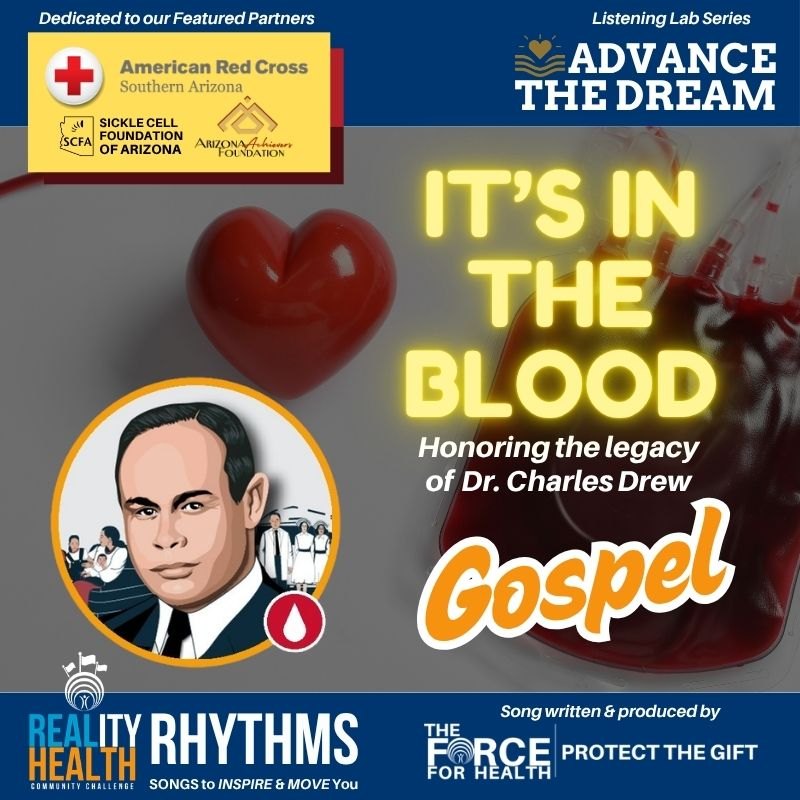
The lyrics
Quick check
The Night in Tucson
September 29, 2026 at The Loft Cinema. Eight moments from the screening, every quote a tap from the exact second it was said.
- 🎬 Part 1 · Welcome
- 🎬 Part 2 · Audience Q&A #1
- 🎬 Part 3 · Audience Q&A #2
- 🎬 Part 4 · Audience Q&A #3
- 🎬 Part 5 · Akilah Gilbert
- …and three more, plus five takeaways
Brought to Tucson in partnership
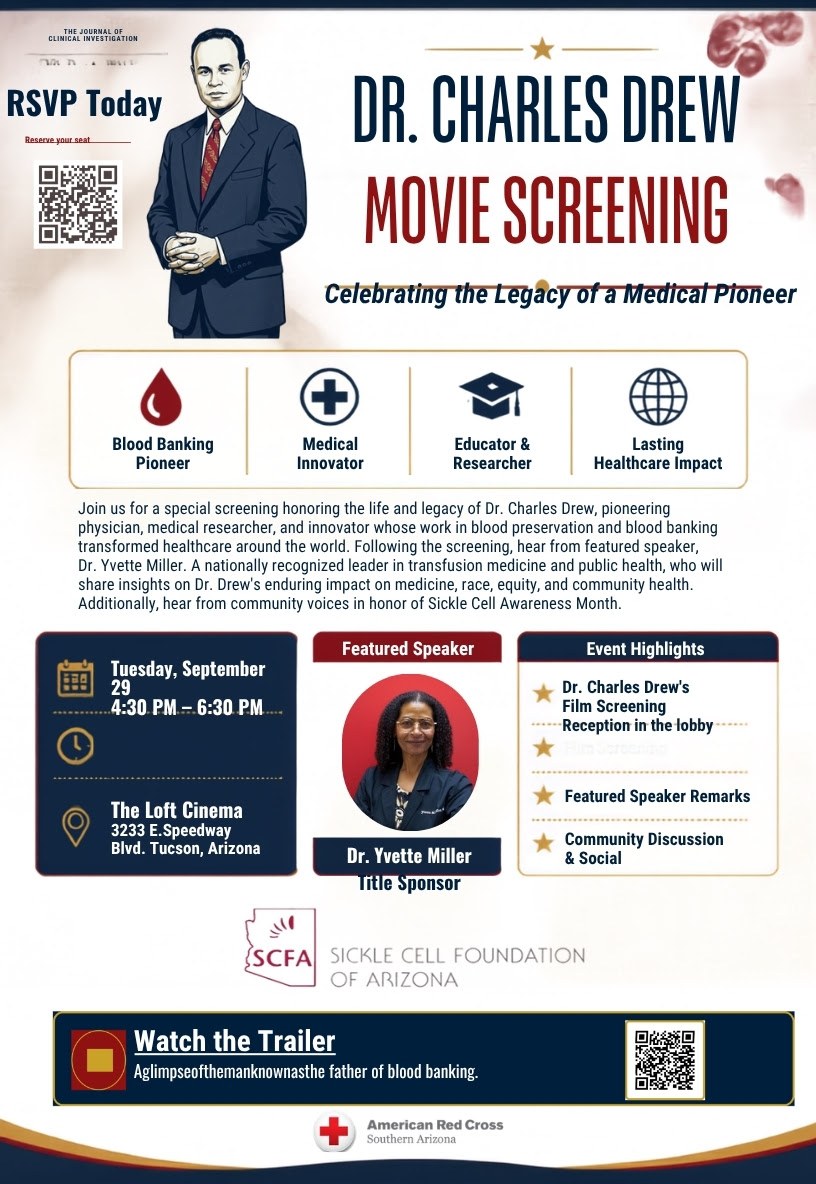
On Tuesday, September 29, 2026, the American Red Cross Southern Arizona, the Sickle Cell Foundation of Arizona and the Arizona Achievers Foundation filled The Loft Cinema to screen the film, hear from featured speaker Dr. Yvette Miller, and ask Tucson to keep his work going.
Welcome: Celebrating the Founder of Blood Banking
Before the lights went down at The Loft, Courtney Slanacker of the American Red Cross Southern Arizona and Samuel Ross of the Arizona Achievers Foundation set the stage: a night to honor Dr. Charles Drew, and a reason to roll up a sleeve.
today we're celebrating Dr. Charles Drew, the founder of blood bankingCourtney Slanacker · plays at 0:15
if we can match them with the right type at the right time, we can provide the best care possible.Courtney Slanacker · plays at 0:58
hopefully we can get more blood donations out of this eventSamuel Ross · plays at 1:25
Audience Q&A #1: Is Blood Still Frozen and Dried?
The documentary shows plasma frozen and dried for World War II. One audience member asked the obvious next question — and the answer brought the history right up to today's sickle cell care.
Is it still done that way so that if we have these blood drives, the blood can be backstopped for those in need?Audience member · plays at 0:06
the majority of blood in this country is kept in a liquid form.Dr. Yvette Miller · plays at 0:15
the Red Cross, our research group, is looking into how we can process and collect and freeze-dry large volumes of plasmaDr. Yvette Miller · plays at 1:08
Audience Q&A #2: Teach Black Excellence — and Who Can Donate?
One of the most moving moments of the night came from a young mother who said the film reminded her to teach her son about the Black leaders who paved the way. Then she asked what keeps people from donating.
I think as a younger Black woman, it's super important to embrace the ability to access informationAudience member · plays at 0:09
they are not eligible to donate red blood cells, but they can donate platelets and plasma, because patients that have sickle cell absolutely need platelets and plasma as well.Dr. Yvette Miller · plays at 1:21
education is nothing unless we have the trustCourtney Slanacker · plays at 2:21
Audience Q&A #3: We Need to Know More About Sickle Cell
A community member named what many in the room felt: most of us know the word sickle cell, but not the disease. She's helping start blood drives again — and wants churches and neighbors back in the room.
We need to really honestly educate the African American why it's important that we give blood.Audience member · plays at 0:22
our major thrust with our sickle cell initiative is educating the Black community.Dr. Yvette Miller · plays at 1:42
having sickle cell trait was protective against dying from malaria.Dr. Yvette Miller · plays at 2:24
Akilah Gilbert: A Warrior's Thank-You
Courtney introduced Akilah Gilbert as someone who supports sickle cell families everywhere — often with the bravest face in the room, even on hard days. Akilah's words were for everyone who showed up.
This is a true warrior right here, and we're so grateful for youCourtney Slanacker · plays at 0:22
As a warrior, we get the blood, but we don't know all the story behind it.Akilah Gilbert · plays at 0:56
to just know that somebody fought that hard to make that possible for me is awesome.Akilah Gilbert · plays at 1:18
Moses Akpan Receives the Sickle Cell Champion Award
The American Red Cross Southern Arizona and the Arizona Achievers Foundation surprised Moses Akpan with the Sickle Cell Champion Award, recognizing his outstanding dedication to sickle cell research and service in the community.
Moses, you're an inspiration to many.Courtney Slanacker · plays at 0:24
Don't stop the fight, and we are all here to support you, my brother.Samuel Ross · plays at 1:24
Dr. Drew didn't leave a trail. He left a highway.Moses Akpan · plays at 2:10
A Call to Action: Dr. Aja Murphy & Crystal Jackson
Red Cross board member Dr. Aja Murphy and 19-year Red Cross veteran Crystal Jackson closed the evening — one speaking frankly about mistrust, the other issuing a call to action for the whole community.
There's a mistrust in our community, and it's well-founded.Dr. Aja Murphy · plays at 1:05
If we'll accept blood, we should be able to donate also and make it a part of the culture.Dr. Aja Murphy · plays at 1:58
If it wasn't for Dr. Charles R. Drew, where would we be with blood transfusions?Crystal Jackson · plays at 4:41
Afterthoughts: What Tucson Took Home
After the credits, we asked people what they'd take home. Their answers ranged from a church restarting its blood drives to a former phlebotomist hearing Dr. Drew's story for the first time.
I think it's so important that we get this message out, and we get it out to all the communityKaren Fontes · plays at 0:30
I can't wait to take this message back to my church familyDominica Christian · plays at 1:11
I'd never heard of him before, and the crazy thing is I'm a former phlebotomistDominica Christian · plays at 1:30
Five takeaways
- Dr. Drew's work is still saving lives. The Red Cross blood program he launched in 1941 is the foundation of today's blood supply — and Tucson came out to honor him.
- A diverse donor base matters most for sickle cell. Many people with sickle cell disease need regular transfusions, and the closest match often comes from donors of similar background.
- People with sickle cell trait can still give. Not red cells — but platelets and plasma, which sickle cell patients need too.
- Trust comes before turnout. Speakers named the community's well-founded mistrust and said trusted partners, family and friends are how education lands.
- The ask is clear: host a drive, give every 56 days, bring someone. Churches, schools, businesses, fraternities, sororities and families were all invited to step up.
Voices from the Loft
Dr. Drew didn't leave a trail. He left a highway.Moses Akpan · Sickle Cell Foundation of Arizona
We have to build the supply before the emergency happens.Crystal Jackson · American Red Cross
As a warrior, we get the blood, but we don't know all the story behind it.Akilah Gilbert · Sickle Cell Warrior & Family Advocate
Our movement goes at the pace of trust, and that's where we're at today.Courtney Slanacker · American Red Cross Southern Arizona
Meet the speakers
Every one of them has a page with their words, each a tap away from the exact moment they said it.
Live It · Share It
Education doesn't end when the credits roll. Meet the Tucson voices, then carry his work forward yourself.
- 🎬 The Tucson screening
- 💬 Voices from the Loft
- 🎙️ Meet the speakers
- 🤝 Take the Drew Pledge
- 🎯 Your badge
Take the Drew Pledge
"The work isn't history if somebody still needs blood." Pick at least one.
Your badge
0 of 300 LEARN It Coins · 0 of 9 squares
Your bingo card fills in as you finish each step of the Iconic Excellence Journey.
🎯 Open my bingo card →Learn it. Live it. Share it.
Sources: American Red Cross and NAACP documentary announcement; "85 Years Later," American Red Cross; Red Cross Blood Services on Dr. Drew. Portrait illustration from Iconic Excellence promotional art, American Red Cross. Tucson quotes are verbatim from the event recording.
 theforce.health · Virtual Library